
Rev. Al Sharpton To Join Big Bethel Ame Church For Souls To The Polls Sunday
Oct 15, 2026
SOULS TO THE POLLS SUNDAY Historic Sweet Auburn congregations unite Oct. 25 for worship, free AI fluency training and a caravan to early voting
Atlanta, GA (PRUnderground) October 15th, 2026
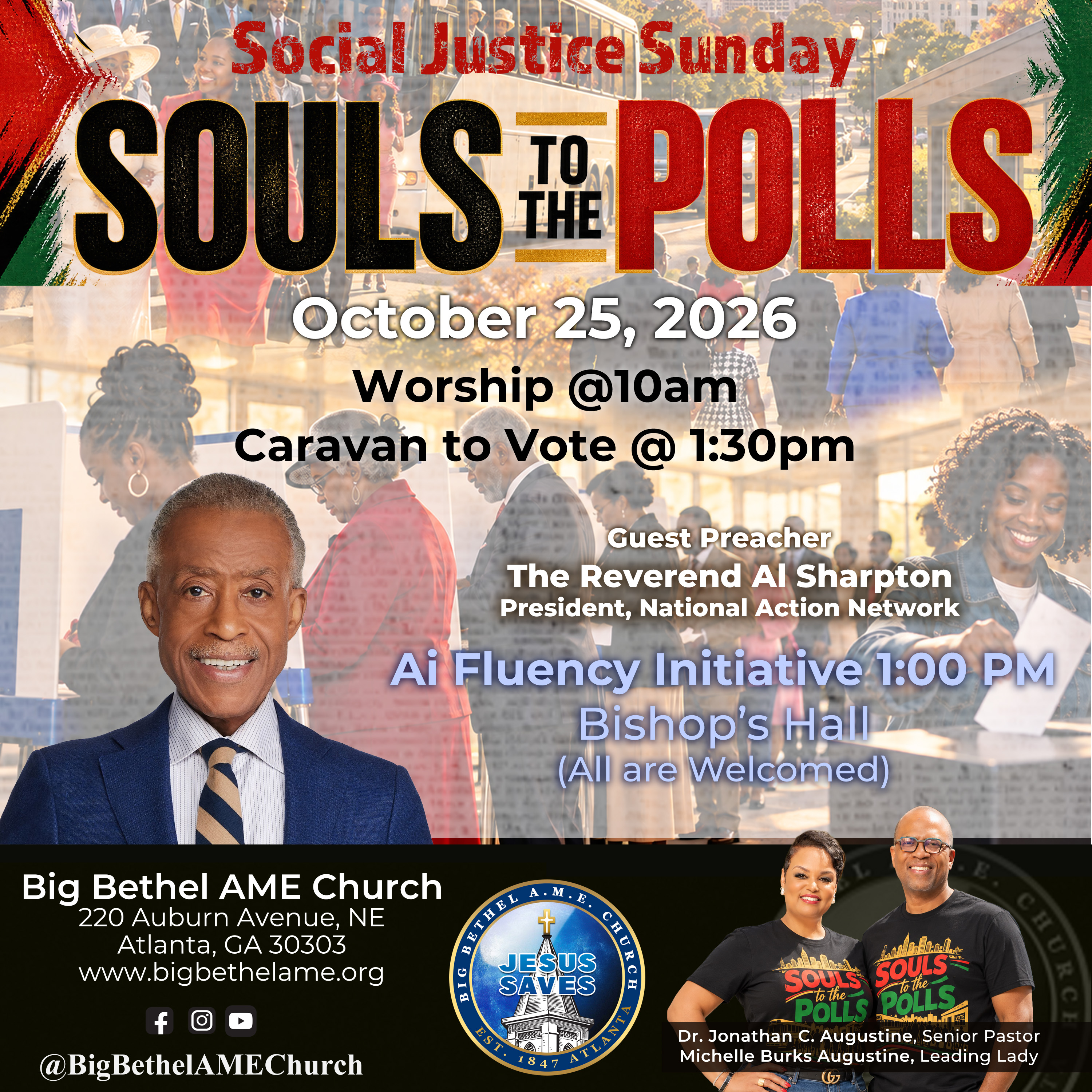
Big Bethel African Methodist Episcopal Church will host Souls to the Polls on Sunday, Oct. 25, bringing together faith leaders, congregants and community members for worship, a free artificial intelligence fluency training session and a voter mobilization effort encouraging Georgians to cast their ballots during the state's early-voting period, which began Tuesday, Oct. 13.
Dr. Jonathan C. Augustine, senior pastor of Big Bethel AME Church, will host the event. The Rev. Al Sharpton, president of the National Action Network and a nationally recognized civil rights activist and minister, will deliver the morning sermon. Worship begins at 10 a.m. at Big Bethel AME Church, 220 Auburn Ave. NE, in Atlanta's Sweet Auburn district. Following worship, attendees can join Sharpton for an AI fluency training session at 1 p.m. in Bishop Hall. The caravan lineup begins at 1:30 p.m. and will conclude at the Joan P. Garner Library, 980 Ponce de Leon Ave. NE.
"The right to vote is powerful, but only when we use it. The Black church has never been limited to what happens inside four sanctuary walls," Augustine said. "We have prayed here, organized here, educated here and challenged this nation to live up to its highest ideals from here. Souls to the Polls is an extension of that ministry. Faith must move us -- and on Oct. 25, we are moving all the way to the polls."
Georgia, often called a battleground state, shows why participation can be consequential. In 2020, the state's presidential contest was decided by 11,779 votes, underscoring how narrow statewide margins can be.
Faith, civic power and the Sweet Auburn legacy
Souls to the Polls is presented in partnership with the Sweet Auburn Collaborative, an alliance of historic faith institutions that includes Big Bethel AME Church, Ebenezer Baptist Church, Our Lady of Lourdes Catholic Church and Wheat Street Baptist Church. Additional partners joining the effort include Jews for Freedom, Faith Rooted ATL, Faith Out Loud and Freedom Forward. Each organization will encourage eligible Georgia voters to verify their voting information, identify an early-voting location, make a voting plan and urge family members, friends and neighbors to participate.
"A church that can shout on Sunday but stays silent when its community needs a voice has misunderstood the gospel. Faith cannot be a spectator sport," Sharpton said. "Our forebears prayed, marched, organized and sometimes bled for the right to vote. We dishonor that sacrifice when we leave our power sitting at home. If you want justice to have a voice, give it your vote."
The initiative reflects the Black church's longstanding role as more than a place of worship. Across generations, Black churches have served as organizing centers, meeting places and community institutions central to civic education, community advancement and voting rights movements.
That legacy is especially significant at Big Bethel. The Auburn Avenue congregation traces its roots to 1847 and has long been associated with civic leadership and social justice. The church says it became known as the "City Hall of Sweet Auburn" because of its history of political organizing and activism. Its pulpit has hosted leaders including Booker T. Washington, Mary McLeod Bethune and Nelson Mandela, as well as a range of contemporary voices.
"This is bigger than one candidate, one party or one election. It is about teamwork, stewardship and community," Augustine said. "That is why our message is simple: Do not underestimate your voice. Do not give away your influence. Every vote matters -- especially yours."
Building AI fluency in the community
The AI fluency training session offers participants a chance to learn how artificial intelligence is transforming how people work, learn, communicate and engage with their communities. The session is free and open to the public, including clergy, community activists and students.
Sharpton underscored the importance of understanding emerging technology and ensuring its benefits are shared widely. Research from Stanford University's Institute for Human-Centered Artificial Intelligence helps explain why. The institute says bias in AI occurs when a system produces results that favor or discriminate against certain groups of people, and that large language models can be biased because of how they are designed, what features they prioritize or how success is measured. That makes it crucial to examine both the data and the goals when building these systems. The issue is especially relevant to AI outcomes involving race, gender, age, employment and political hot-button issues.
"Every generation of this movement has had to fight for a seat at the table, and artificial intelligence is the next table," Sharpton said. "If we don't understand this technology, it will be built without us, used on us and decided for us. We must demand that it be used ethically and fairly -- and we must learn it well enough to put it to work for our people, our businesses and our children. We will not be locked out of this future."
Press Contact
Name: Lalohni Campbell Phone: 404.593.7145 Email: Contact UsOriginal Press Release.
More News











Recommended








YOUR NEWS, OUR NETWORK.
Do you have Great News you want to tell the world?
Be it updates about your business or your community, you can make sure that it’s heard by submitting your story to our network reaching hundreds of news sites across 6 verticals.